There is a lot of legacy information about gain staging still floating around. I learned this in the analog days, when the signal path was microphone, microphone preamp, mixer, and finally the recorder. Every stage added potential noise or distortion, and you learned how to balance the levels through the chain to minimize both.
The theory still stands today. Every additional analog gain stage introduces another noise contribution and another overload point. If its gain is unnecessary, it can reduce system headroom without improving the useful signal-to-noise ratio.
What has changed is the equipment. A modern recording chain is often microphone → microphone preamp → A/D converter. The converter may be in an interface or in a field recorder. Modern preamps can have extremely low noise, and modern 24-bit converters can provide well over 100 dB of real analog dynamic range. That changes how we should think about gain.
Back in the fully analog studio I would never deliberately run a signal 20 dB below nominal operating level into a 2-inch 24-track machine. Nor would I set the microphone preamp so low that I needed another 10 or 20 dB of gain in the mixer. With today's converters, those instincts can cause us to use more analog gain than we actually need.
First, what does a dB mean?
A decibel by itself is only a ratio. It becomes an absolute measurement when we attach a reference. dB SPL uses 20 µPa of acoustic pressure as its reference. dBV uses 1 Vrms. dBu uses 0.775 Vrms.
The microphone is the device that connects those acoustic and electrical worlds. It converts sound pressure into voltage.
For the microphone used in these examples, the TSC-1 capsule sensitivity is −35 dBV/Pa. One pascal is approximately 94 dB SPL and produces 17.78 mVrms from the capsule. My OPA impedance converter has unity gain on each leg, but drives the two balanced legs with opposite polarity, so the differential output at the XLR is 35.57 mVrms/Pa.
Where does the headroom actually go?
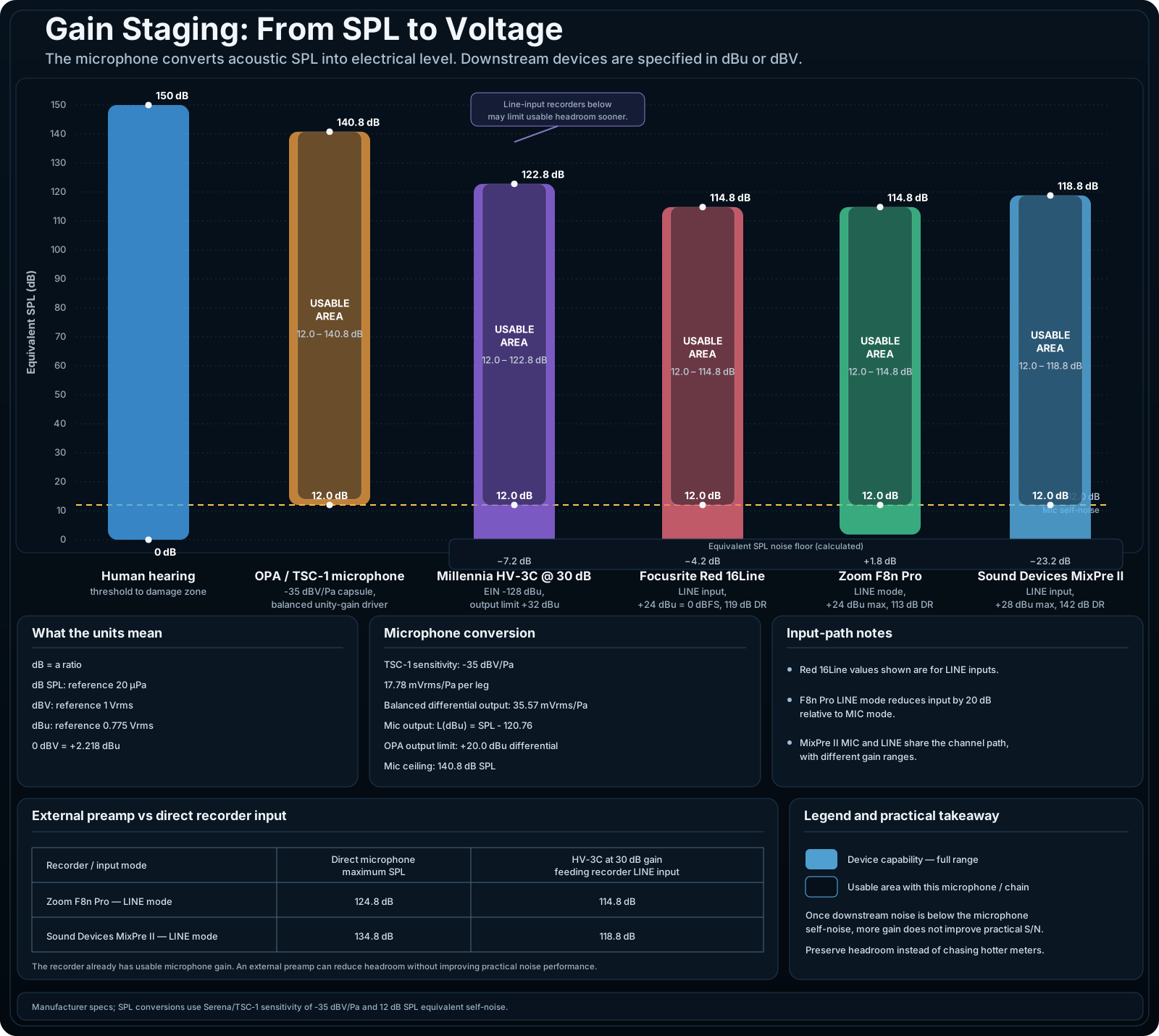
The first graphic puts the entire signal chain on one equivalent-SPL scale. The Serena microphone itself spans from about 12 dB SPL equivalent self-noise to an electronics ceiling of about 140.8 dB SPL. From there, each downstream device can narrow the usable range.
With a Millennia HV-3C set for 30 dB of gain, its output capability corresponds to about 122.8 dB SPL at the microphone. Feed that into a Focusrite Red 16Line line input set for +24 dBu = 0 dBFS, and the converter becomes the limiting stage at about 114.8 dB SPL.
The same issue appears when an external microphone preamp is connected to the line input of a field recorder. The Zoom F8n Pro accepts +24 dBu in Line mode, while the MixPre II accepts +28 dBu. An external 30 dB preamp can therefore consume substantial headroom before either recorder actually needs the extra gain.
This is particularly interesting with the F8n Pro because its Line setting reduces the input by 20 dB relative to Mic mode. We can amplify the microphone externally, then attenuate it again at the recorder. There may be good reasons to do that — a transformer, coloration, routing, or a particular preamp sound — but lower noise is not automatically one of them.
How much analog gain is enough?
When I presented my AES paper on my operational-amplifier microphone impedance converter, the very next presentation examined the same question from another direction: whether additional gain should be applied in the analog domain or digitally after conversion.
Dennis Fink and Rosalfonso Bortoni's AES Express Paper, Analog and Digital Gain in Microphone Preamplifier Design, models source noise, preamp equivalent input noise, and ADC noise as independent contributors. Their important result was not that there is one correct gain setting. It was that once enough analog gain has been applied, additional analog gain provides rapidly diminishing improvement because the microphone and preamp noise already dominate the converter noise.
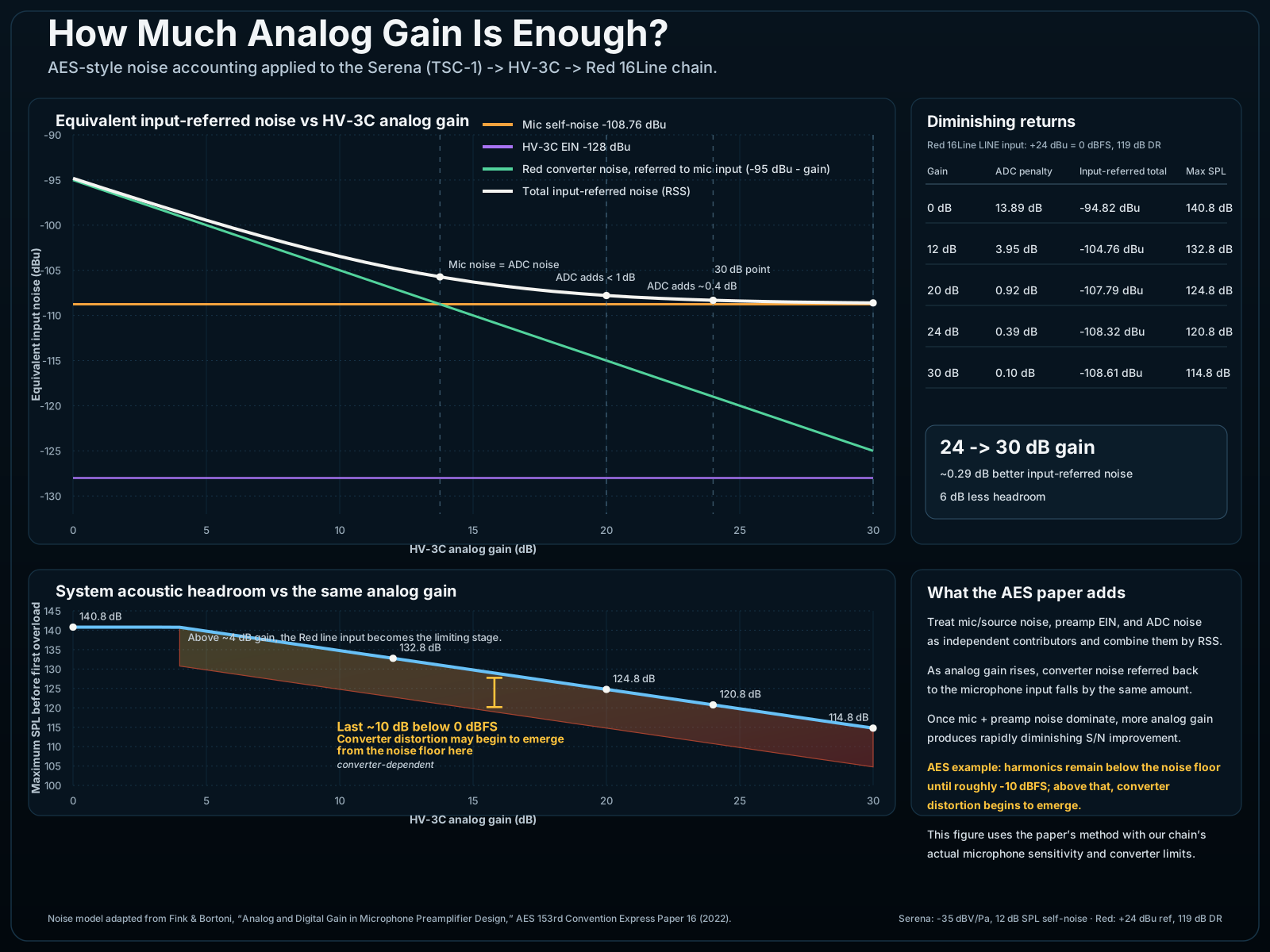
For our example, the microphone's 12 dB SPL equivalent self-noise corresponds to about −108.76 dBu at the balanced output. The HV-3C has an EIN around −128 dBu, about 19 dB below the microphone noise. Combined by power, the preamp raises the microphone noise by only about 0.05 dB, so the microphone still dominates the analog noise.
Using the Red 16Line line input at its +24 dBu reference and 119 dB dynamic range gives a converter noise level of roughly −95 dBu. With no preamp gain, converter noise matters. But every dB of analog gain lowers the converter noise by one dB when it is referred back to the microphone input.
By about 20 dB of analog gain, the ADC contributes less than 1 dB to the total input-referred noise. At about 24 dB, its contribution is only around 0.4 dB. Increasing the preamp from 24 to 30 dB improves the calculated input-referred noise by only about 0.29 dB — but it costs 6 dB of acoustic headroom.
What about distortion?
There is another reason not to use more analog level than necessary. The AES paper examined a delta-sigma ADC and found that, in their example, harmonic products remained below the converter noise floor over a very wide range of levels. They began to emerge from the noise floor only in roughly the final 10 dB approaching 0 dBFS.
That does not make −10 dBFS a universal distortion threshold; converter designs differ. It does show that there is no special fidelity advantage to pushing a modern converter close to 0 dBFS. Once the converter noise is comfortably below the microphone and preamp noise, additional analog gain buys very little while consuming headroom and moving the analog stages and converter closer to their nonlinear regions.
The practical takeaway
- Use enough analog gain — but no more than necessary.The microphone preamp needs sufficiently low noise, and enough gain that the downstream A/D converter no longer significantly raises the noise floor set by the microphone and preamp.
- Additional analog gain lowers overall system headroom.Once converter noise is no longer significant, more preamp gain produces very little improvement in signal-to-noise ratio while moving the signal closer to overload.
- Leave room below full scale.Keeping normal peaks roughly 10 dB or more below 0 dBFS keeps the converter away from the region where harmonic distortion may begin to emerge from its noise floor. The exact point is converter-dependent.
- For the cleanest signal path, use the field recorder’s internal mic preamps.Most “high-end” mic preamps are more likely to close in on your wallet than to make the signal more pristine. My goal is to get the signal into the A/D converter as cleanly as possible. You can always add distortion, harmonic sweetening, presence, or whatever other coloration you want in post. Once it is already in the recording, you cannot remove it.
References & further reading
- Fink & Bortoni — Analog and Digital Gain in Microphone Preamplifier DesignAES 153rd Convention Express Paper 16, October 2022.
- Focusrite Red 16LineLine-input reference level and dynamic-range specifications.
- Zoom F8n Pro Operation ManualLine-mode input behavior and level specifications.
- Sound Devices MixPre II SpecificationsMic/line gain ranges and maximum input levels.